
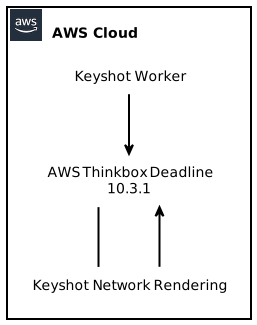
AWS Thinkbox Deadline 10.3.1 is an advanced job scheduler and management system designed for seamless integration with cloud rendering solutions. This major release introduces a groundbreaking feature – support for Keyshot Network Rendering.
In this comprehensive guide, we will explore the various aspects of AWS Thinkbox Deadline 10.3.1 and delve into the technical details of the newly added Keyshot Network Rendering support. We will also highlight key SEO best practices to ensure optimum visibility of your rendered content on search engines.
Table of Contents
- Introduction
- Keyshot Network Rendering Overview
- AWS Thinkbox Deadline 10.3.1
- History and Evolution of Deadline
- Key Features of Deadline 10.3.1
- Installation and Configuration
- Prerequisites
- Step-by-Step Installation Guide
- Keyshot Worker Integration
- Compatibility and Requirements
- Setting Up Keyshot Worker
- Configuring Deadline for Keyshot Network Rendering
- Technical Details of Keyshot Network Rendering
- How Keyshot Worker Operates
- Switching Between Deadline and Keyshot Queues
- Resource Management and Optimization
- Load Balancing Techniques
- Failover and Fault Tolerance Mechanisms
- SEO Best Practices for Rendered Content
- Optimizing Image Titles and Descriptions
- Structured Data Markup for Rich Snippets
- XML Sitemaps for Images
- Page Speed and Rendering Performance
- Mobile Friendliness and Responsiveness
- Backlink Building Strategies
- Utilizing Social Media Platforms
- Conclusion
2. Keyshot Network Rendering Overview
Keyshot Network Rendering is a distributed rendering solution provided by Luxion, the creators of Keyshot, a popular 3D rendering and animation software. It allows users to offload rendering tasks to multiple machines, significantly reducing the time required for complex rendering projects.
With the integration of Keyshot Network Rendering into AWS Thinkbox Deadline 10.3.1, customers can now seamlessly harness the power of both Keyshot and Deadline, automating the process of switching between different rendering queues without the need for manual intervention.
3. AWS Thinkbox Deadline 10.3.1
3.1 History and Evolution of Deadline
Deadline, developed by AWS Thinkbox, has long been the industry-standard in job scheduling and management for rendering engines. With each update, it has evolved to meet the growing demands of the visual effects, animation, and game development industries.
3.2 Key Features of Deadline 10.3.1
AWS Thinkbox Deadline 10.3.1 introduces several new features and enhancements that enhance efficiency, scalability, and flexibility for rendering workloads. Some key features include:
- Native integration with leading 3D applications and rendering engines
- Intelligent job scheduling and dependency management
- Support for hybrid on-premises and cloud rendering environments
- Advanced resource management and load balancing
- Secure data transfer and encryption protocols
- Scalable and fault-tolerant architecture
3.3 Installation and Configuration
Prerequisites
Before installing AWS Thinkbox Deadline 10.3.1, ensure your system meets the minimum requirements for compatibility. These include:
- Supported operating systems
- Required hardware specifications
- Dependency libraries and applications
Step-by-Step Installation Guide
This section will provide a detailed step-by-step guide to installing AWS Thinkbox Deadline 10.3.1 on your local network or cloud infrastructure. We will guide you through the following stages:
- Downloading the installation package
- Preparing the installation environment
- Running the installation wizard
- Configuring the Deadline Repository
- Setting up the Deadline Worker
3.4 Keyshot Worker Integration
Compatibility and Requirements
To fully leverage the Keyshot Network Rendering support in AWS Thinkbox Deadline 10.3.1, you need to ensure compatibility and meet the necessary requirements. This includes:
- Supported versions of Keyshot and Keyshot Worker
- License and network connectivity
- System hardware requirements
Setting Up Keyshot Worker
In this section, we will explain how to set up and configure Keyshot Worker to work seamlessly with AWS Thinkbox Deadline. We will cover topics such as license configuration, network settings, and worker management.
Configuring Deadline for Keyshot Network Rendering
To enable successful integration of Keyshot Network Rendering with Deadline, specific configurations and settings are required. This section will provide a detailed walkthrough of the necessary steps to ensure smooth communication and resource utilization between Deadline and Keyshot.
4. Technical Details of Keyshot Network Rendering
How Keyshot Worker Operates
Keyshot Worker plays a crucial role in enabling distributed rendering capabilities with Keyshot. This section will dive into the inner workings of Keyshot Worker, explaining the rendering process, task allocation, and communication protocols between workers and the Deadline infrastructure.
Switching Between Deadline and Keyshot Queues
The ability to seamlessly switch between the Deadline rendering queue and the Keyshot rendering queue is a groundbreaking feature of AWS Thinkbox Deadline 10.3.1. This section will detail the technical implementation of this feature, including task routing logic, prioritization, and load balancing algorithms.
Resource Management and Optimization
Efficient resource management is key to optimizing rendering workflows. We will discuss various resource management techniques employed by AWS Thinkbox Deadline 10.3.1, focusing on factors like CPU and GPU utilization, memory management, and job prioritization strategies.
Load Balancing Techniques
Load balancing is crucial for distributing rendering tasks across multiple machines to maximize efficiency. This section will explore different load balancing algorithms used in AWS Thinkbox Deadline 10.3.1, including round-robin, least connections, and weighted based approaches.
Failover and Fault Tolerance Mechanisms
Rendering workloads are often time-sensitive and require high availability. To ensure uninterrupted processing in the face of failures, AWS Thinkbox Deadline 10.3.1 incorporates failover and fault tolerance mechanisms. We will delve into how these mechanisms function and how they can be configured for robustness and reliability.
5. SEO Best Practices for Rendered Content
With the rise of visual search and the increasing popularity of rendered content on the web, it is crucial to optimize your rendered assets for enhanced search engine visibility. This section will explore SEO best practices specific to rendered content, including:
Optimizing Image Titles and Descriptions
Properly optimizing the titles and descriptions of your rendered images is vital for search engine crawlers to understand and index your content accurately. We will provide practical tips and guidelines for crafting relevant and keyword-rich image titles and descriptions.
Structured Data Markup for Rich Snippets
Implementing structured data markup enables search engines to understand your rendered content and display rich snippets in search results. We will explain how to leverage schema markup to provide additional context and improve the visibility and click-through rates of your rendered content.
XML Sitemaps for Images
XML sitemaps are essential for search engines to discover and index your rendered images efficiently. We will guide you through the process of creating and submitting XML sitemaps specifically for rendering projects, ensuring optimal crawling and indexing by search engine bots.
Page Speed and Rendering Performance
Fast page loading times are crucial for user satisfaction and search engine ranking. We will explore techniques to optimize your rendering workflows for improved rendering performance and reduced page loading times, including caching, server-side rendering, and content delivery networks (CDNs).
Mobile Friendliness and Responsiveness
Ensuring that your rendered content is mobile-friendly and responsive is essential in today’s mobile-first world. We will highlight the importance of responsive design for rendering projects and discuss strategies for optimizing your content’s display and performance on various mobile devices.
Backlink Building Strategies
Backlinks from authoritative websites can significantly boost the visibility and ranking of your rendered content. We will provide actionable tips and strategies for acquiring high-quality backlinks within the rendering industry and related niches.
Utilizing Social Media Platforms
Leveraging social media platforms to showcase and promote your rendered content is an effective way to broaden your reach and attract a wider audience. We will discuss the key social media platforms for rendering projects and provide best practices for maximizing engagement and exposure.
6. Conclusion
In conclusion, AWS Thinkbox Deadline 10.3.1 brings unparalleled integration with Keyshot Network Rendering, revolutionizing the rendering workflow for visual effects and animation professionals. This guide has provided a comprehensive overview of the features and technical aspects of AWS Thinkbox Deadline 10.3.1, with a specific focus on Keyshot Network Rendering. We have also explored SEO best practices for optimizing rendered content, ensuring maximum visibility on search engines and social media platforms. By following the guidelines in this guide, you can harness the full potential of AWS Thinkbox Deadline 10.3.1 and Keyshot Network Rendering, unlocking new levels of rendering efficiency and productivity.