
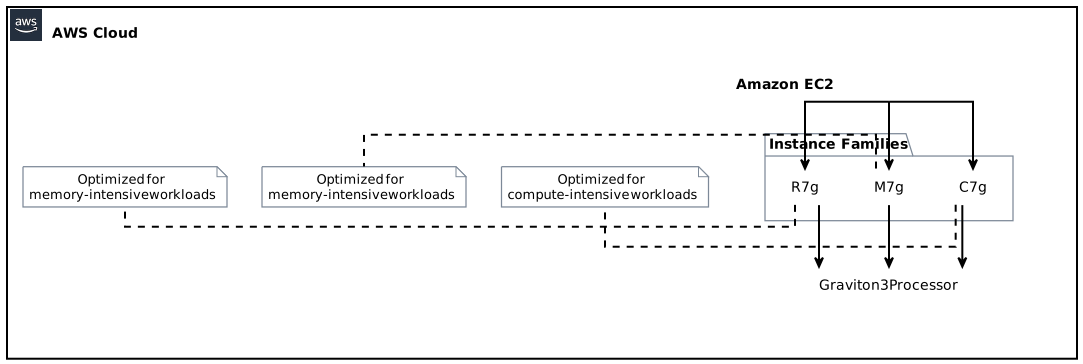

Amazon EC2 (Elastic Compute Cloud) is a web-based service that provides scalable compute capacity in the cloud. It allows developers to launch virtual servers known as instances, on demand, with customizable configurations. Amazon EC2 is highly flexible, reliable, and offers a wide range of instances to cater to various computing needs.
In this comprehensive guide, we will dive into the details of the Amazon EC2 C7g, M7g, and R7g instances, along with the usage of the Graviton3 technology. We will understand how these instances are designed to improve performance, scalability, and energy efficiency, while reducing the carbon footprint of your cloud infrastructure. Additionally, we will explore their technical specifications, features, and deployment in various AWS regions.
Table of Contents
- Introduction to Amazon EC2 and Instance Types
- Understanding the C7g, M7g, and R7g Instances
- Overview of Graviton3 Technology
- Improving Energy Efficiency with Graviton3 Instances
- Comparing C7g, M7g, and R7g Instances
- Technical Specifications and Features
- Networking Bandwidth and Storage Capacity
- Compatibility and Migration Considerations
- Availability in AWS Regions
- Best Practices for Utilizing C7g, M7g, and R7g Instances
- Conclusion
1. Introduction to Amazon EC2 and Instance Types
Amazon EC2 revolutionized the cloud computing industry by introducing a scalable and cost-effective way to utilize virtual servers in the cloud. It eliminated the need for upfront hardware investments, allowing businesses to pay only for the computing resources they use.
Instance types in Amazon EC2 are pre-configured templates that define the computing resources available to a virtual server. They vary in terms of CPU, memory, storage, and networking capacity, catering to diverse application workloads.
C7g, M7g, and R7g are newer instance families in Amazon EC2 that harness the power of Arm-based processors, leveraging the Graviton3 technology. These instances offer improved performance and higher energy efficiency compared to their predecessors. Let us explore these instances in more detail.
2. Understanding the C7g, M7g, and R7g Instances
The C7g, M7g, and R7g instances are part of the Graviton2-based instance families. These instances are powered by custom-designed AWS Graviton3 processors, built on 7nm technology. They are optimized for a broad range of workloads, including application servers, microservices, high-performance computing (HPC), gaming servers, and more.
a. C7g Instances
The C7g instances are compute-optimized instances that deliver outstanding performance for compute-intensive workloads. They are suitable for applications that require significant CPU power, such as batch processing, distributed analytics, and scientific simulations. C7g instances offer a balanced ratio of CPU cores to memory, making them ideal for memory-intensive workloads as well.
b. M7g Instances
M7g instances are memory-optimized instances that prioritize memory capacity and bandwidth. These instances are ideal for memory-intensive workloads, such as in-memory databases, real-time big data analytics, caching fleets, and more. M7g instances provide a high memory-to-CPU ratio, enabling efficient processing of large datasets.
c. R7g Instances
The R7g instances fall under the storage-optimized instance family. They are specifically designed for applications that require large amounts of local storage. R7g instances are well-suited for data warehousing, log processing, and distributed file systems. With ample storage and high disk throughput, R7g instances excel in scenarios involving heavy read/write operations.
3. Overview of Graviton3 Technology
Graviton3 technology forms the foundation of the C7g, M7g, and R7g instances. It is the latest generation of Arm-based processors developed by Amazon Web Services. These processors are custom-designed with a focus on delivering exceptional performance, energy efficiency, and cost-effectiveness.
a. Performance Advantages
Graviton3 processors leverage Arm Neoverse cores, which are known for their efficiency and scalability. These cores deliver higher clock speeds, improved performance per core, and enhanced multi-threading capabilities. Graviton3 processors exhibit significant gains in floating-point performance, cryptographic workloads, and overall CPU throughput, resulting in better application responsiveness and reduced processing times.
b. Energy Efficiency and Reduced Carbon Footprint
One of the notable advantages of Graviton3 instances is their energy efficiency. They are designed to provide up to 60% less energy consumption for the same performance compared to comparable EC2 instances. By utilizing Graviton3 instances, you can reduce your cloud carbon footprint and contribute to a more sustainable environment.
c. Cost-Effective Computing
Graviton3 instances offer cost savings due to their efficient use of resources. With improved performance per watt, these instances can deliver excellent price-to-performance ratios. By leveraging Graviton3 technology, you can optimize your infrastructure costs without compromising on performance or scalability.
4. Improving Energy Efficiency with Graviton3 Instances
Energy efficiency has become a crucial aspect of modern computing, and Amazon EC2 addresses this concern effectively with the Graviton3 instances. Let us delve deeper into how Graviton3 instances contribute to energy savings and reduce the carbon footprint of your cloud infrastructure.
a. Higher Energy Efficiency Ratio
The Graviton3 processors are designed using advanced manufacturing processes and Arm Neoverse architecture principles. These processors achieve better performance per watt by efficiently utilizing the available resources. With lower energy consumption, Graviton3 instances directly translate into reduced electricity usage and associated costs.
b. Cloud Carbon Footprint Reduction
Amazon EC2 Graviton3 instances are optimized to provide the same performance as comparable instances while using up to 60% less energy. This reduction in energy consumption leads to a proportional decrease in carbon emissions. By employing Graviton3 instances, you can substantially reduce your cloud infrastructure’s carbon footprint, contributing to a greener and more sustainable cloud ecosystem.
c. Sustainable Computing
Sustainability is a top priority for many organizations. By adopting Graviton3 instances, you can align your cloud infrastructure with sustainable computing practices. The energy-efficient design and reduced carbon footprint of Graviton3 instances make them an environmentally friendly choice. This not only helps in meeting sustainability goals but also enhances your brand image as a responsible and green-conscious organization.
5. Comparing C7g, M7g, and R7g Instances
While the C7g, M7g, and R7g instances share the Graviton3 technology, they differentiate themselves based on specific workload requirements. Let’s compare these instance families to identify the best fit for your applications.
a. CPU Performance
The C7g instances offer a higher number of compute cores, making them well-suited for CPU-intensive workloads. With their balanced CPU-to-memory ratio, they can handle both compute-intensive and memory-bound applications effectively. The C7g instances excel in batch processing, distributed analytics, and simulations.
On the other hand, the M7g instances focus on memory capacity and bandwidth, offering a high memory-to-CPU ratio. These instances deliver excellent performance for memory-intensive workloads that involve in-memory processing, data caching, and analytics. Applications like real-time big data analysis and in-memory databases can benefit significantly from M7g instances.
c. Local Storage and Disk Throughput
The R7g instances are storage-optimized and feature high local storage capacities. They are designed to handle workloads that demand extensive storage and perform heavy read/write operations. Applications like data warehousing, log processing, and distributed file systems can take advantage of R7g instances’ abundant disk space and high disk throughput.
d. Price-to-Performance Ratio
The price-to-performance ratio of C7g, M7g, and R7g instances is exceptionally favorable, making them cost-effective options for a wide range of workloads. When compared to equivalent x86-based instances, Graviton3 instances provide comparable or even better performance at a lower cost.
6. Technical Specifications and Features
To maximize the potential of C7g, M7g, and R7g instances, it is essential to understand their technical specifications and features. Let’s explore the key details that differentiate these instances and empower you to make informed decisions regarding your workloads.
a. Processor
All three instance families (C7g, M7g, and R7g) are powered by AWS Graviton3 processors. Graviton3 processors feature Arm Neoverse cores that offer enhanced performance, energy efficiency, and scalability. The custom design of these processors ensures optimal resource utilization and responsiveness for your applications.
b. CPU Cores
The number of CPU cores varies across the C7g, M7g, and R7g instances. For example, the c6g.xlarge instance in the C7g family has 4 CPU cores, while the m6g.xlarge instance in the M7g family has 8 CPU cores. The number of CPU cores is an important consideration while selecting an instance type, as it determines the maximum parallel tasks your application can handle.
c. Memory
Memory capacity is another critical aspect when choosing an instance type. The C7g, M7g, and R7g instances offer a wide range of memory options to address varying application requirements. Instances within the Graviton3 families can have memory capacities ranging from a few gigabytes to several terabytes, enabling you to provision the optimal amount of memory for your workloads.
d. Network Performance
Graviton3 instances are equipped with high-speed networking capabilities for seamless communication and data transfer. These instances provide up to 30 Gbps of networking bandwidth, enabling efficient data exchange between instances and other services within the AWS ecosystem. When building distributed systems or applications that rely on fast inter-instance communication, the network performance of Graviton3 instances is a significant advantage.
e. Instance Sizes and Flexibility
The C7g, M7g, and R7g families offer a range of instance sizes to accommodate different workload requirements. The available sizes include smaller instances suitable for low-scale applications to larger instances capable of handling high-performance or memory-intensive workloads. This flexibility allows you to choose the ideal instance size based on your application’s resource needs.
f. Instance Metadata
Instance metadata is a valuable feature provided by Amazon EC2 instances. It allows your applications to access information about themselves, such as instance ID, region, availability zone, and more. This metadata is useful for automation scripts, monitoring tools, and dynamic configuration management. Graviton3 instances fully support instance metadata, enabling you to utilize this feature seamlessly in your applications.
7. Networking Bandwidth and Storage Capacity
Networking bandwidth and storage capacity are critical factors when determining the suitability of an instance type for specific workloads. Let’s explore the networking and storage capabilities of the C7g, M7g, and R7g instances.
a. Networking Bandwidth
Graviton3 instances provide up to 30 Gbps of networking bandwidth. This high bandwidth ensures fast and reliable communication between instances, allowing your applications to operate efficiently in a distributed environment. For use cases that demand low-latency network communications, Graviton3 instances offer excellent performance and responsiveness.
b. Amazon Elastic Block Store (EBS) Bandwidth
The Amazon Elastic Block Store (EBS) is a block-level storage service provided by Amazon EC2. Graviton3 instances offer up to 20 Gbps of bandwidth to the Amazon EBS, ensuring fast and reliable access to block-level storage. This high EBS bandwidth enables efficient data processing and storage operations, avoiding any performance bottlenecks.
c. Local Storage Capacity
The R7g instances, being storage-optimized, provide large amounts of local storage. This local storage capacity is beneficial for applications that require extensive data storage for processing and analysis. Depending on the instance size, the R7g family offers several terabytes of NVMe-based local storage, enabling efficient data handling within the instance itself.
d. Elastic Network Interfaces (ENIs)
Graviton3 instances support Elastic Network Interfaces (ENIs), which are virtual network interfaces that you can attach to your instances. ENIs provide additional network capacity and flexibility to your instances, allowing you to create complex network architectures. By utilizing ENIs, you can configure your instances to meet specific networking requirements and achieve optimal network performance.
8. Compatibility and Migration Considerations
When adopting new instance families like C7g, M7g, and R7g, compatibility and migration considerations become crucial. Let’s explore the compatibility aspects of the Graviton3 instances and understand the migration options available to ensure a seamless transition for your workloads.
a. Operating Systems and Applications
Graviton3 instances are compatible with several popular operating systems, including Amazon Linux 2, Ubuntu, and Red Hat Enterprise Linux (RHEL). These instances also support a wide range of applications and software frameworks. However, it is recommended to check the official documentation and compatibility guidelines to ensure compatibility with specific software versions.
b. Containerization and Orchestration
Containerization technologies like Docker and orchestration platforms like Kubernetes seamlessly support Graviton3 instances. Containerizing your applications allows you to achieve rapid deployment, scalability, and portability even when migrating between different instance families. Additionally, containerizing your applications provides independent control over application dependencies, facilitating a smooth transition to Graviton3 instances.
c. Migration Strategies
Migrating your applications to Graviton3 instances can be a straightforward process with proper planning and execution. Here are some migration strategies to consider:
Lift-and-Shift: This approach involves migrating your existing applications as-is to Graviton3 instances. It requires minimal changes to the application code or architecture and is useful when quick migration is desired.
Re-Architecting: If you prefer to optimize your applications for Graviton3 instances, re-architecting entails modifying the application design and code to take advantage of the unique capabilities of Graviton3 technology. This approach allows you to achieve better performance and cost optimization.
Phased Migration: In a phased migration approach, you gradually move different components or modules of your application to Graviton3 instances. This can be helpful when dealing with complex architectures or dependencies that require a step-by-step migration plan.
Proof of Concept: Before committing entirely to Graviton3 instances, you can run a proof of concept leveraging the Graviton3 instances to evaluate their performance and suitability for your workloads. This helps gather valuable insights and make informed decisions before a full migration.
9. Availability in AWS Regions
Amazon EC2 Graviton3 instances, including the C7g, M7g, and R7g families, are available in various AWS regions worldwide. Here are some of the AWS regions where Graviton3 instances are available:
- US East (N. Virginia)
- US West (Oregon)
- Europe (Ireland)
- Asia Pacific (Tokyo)
- South America (Sao Paulo)
The availability of Graviton3 instances in multiple regions allows you to deploy your applications closer to end-users, reducing latency and optimizing network performance. Additionally, it provides geographical resilience for your workloads, enabling efficient disaster recovery and business continuity strategies.
Please refer to the official AWS documentation for the complete list of AWS regions supporting Graviton3 instances and their specific availability zones.
10. Best Practices for Utilizing C7g, M7g, and R7g Instances
To fully leverage the capabilities of C7g, M7g, and R7g instances and Graviton3 technology, here are some best practices to consider during utilization:
Performance Optimization: Understand the requirements and characteristics of your applications to select the most suitable instance family (C7g, M7g, or R7g) for optimal performance. Consider the CPU, memory, and network requirements of your workloads before making a decision.
Containerization: Containerize your applications using Docker or other containerization technologies to achieve portability and scalability across different instance families. Containerization enables easier migration and reduces dependencies on specific instance types.
Continuous Performance Monitoring: Regularly monitor the performance and resource utilization of your Graviton3 instances. AWS provides various monitoring tools like Amazon CloudWatch, which offer insights into CPU utilization, memory usage, network and storage performance. By analyzing these metrics, you can identify bottlenecks and optimize your application’s resource allocation.
Auto Scaling: Utilize auto scaling capabilities provided by Amazon EC2 to automatically adjust the number of instances based on application demand. Auto scaling ensures your application scales seamlessly during peak traffic periods while optimizing costs during periods of low traffic.
Cost Optimization: Graviton3 instances offer cost savings compared to traditional x86-based instances. Optimize the cost of your cloud infrastructure by selecting the appropriate instance sizes, leveraging spot instances for non-production workloads, and adopting cost optimization strategies provided by AWS.
Security Best Practices: Apply AWS security best practices to safeguard your applications and data. This includes implementing strong access controls, encrypting data at rest and in transit, setting up security groups and network ACLs, and staying updated with the latest security patches.
11. Conclusion
In conclusion, Amazon EC2 C7g, M7g, and R7g instances, powered by Graviton3 technology, offer significant advantages in terms of performance, energy efficiency, and scalability. These instances provide a compelling alternative to traditional x86-based instances, delivering comparable or better performance at a lower cost. Additionally, they contribute to reducing the carbon footprint of your cloud infrastructure by utilizing up to 60% less energy for the same performance.
By understanding the technical specifications, networking capabilities, storage options, and migration considerations, you can make informed decisions for deploying the C7g, M7g, and R7g instances in your applications. With their availability in multiple AWS regions, you can optimize your infrastructure for performance, cost, and latency requirements.
Embracing Graviton3 instances and leveraging the inherent benefits of Arm-based processors sets the stage for a more sustainable and efficient cloud computing environment. Incorporating best practices for utilization ensures seamless migration, improved performance, and cost optimization for your workloads.
By harnessing the power of Amazon EC2 C7g, M7g, and R7g instances and Graviton3 technology, you can unlock new possibilities for your applications in the cloud. Upgrade your computing capabilities, achieve higher scalability, reduce costs, and contribute to an eco-conscious cloud ecosystem with Gr