
Introduction
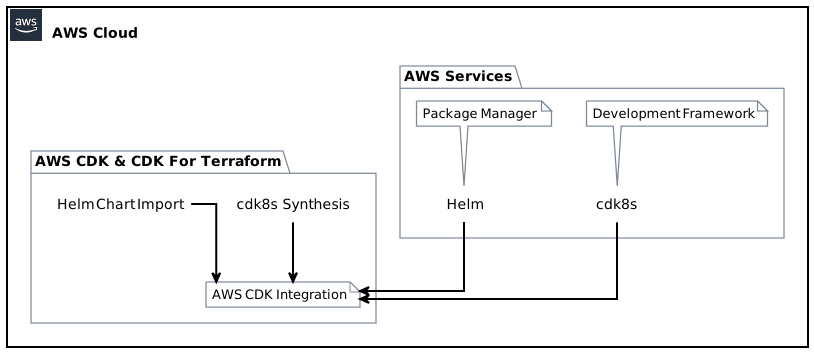
AWS has recently introduced new capabilities for cdk8s, providing seamless synthesis of applications into Helm charts and the native import of existing Helm charts into cdk8s applications. Furthermore, cdk8s now supports the interpretation of deploy-time tokens from AWS CDK and CDK For Terraform, all within the synthesis phase. This integration between cdk8s and Helm offers users a unified workflow for the creation and deployment of Kubernetes manifests. In this guide, we will explore these new features in detail, highlighting their significance and providing insights into their technical implementation.
Table of Contents
- Overview of cdk8s
- Introduction to Helm
- Synthesizing cdk8s Applications into Helm Charts
- Understanding the “cdk8s synth” Command
- Transforming a cdk8s App into a Helm Chart
- Integration with Helm Deployments
- Importing Existing Helm Charts into cdk8s Applications
- Benefits of Importing Helm Charts
- Importing Helm Charts with cdk8s
- Leveraging cdk8s with Helm Chart Imports
- Resolving Cloud Tokens in cdk8s
- Introduction to AWS CDK and CDK For Terraform
- Deploy-Time Tokens and their Importance
- Support for Deploy-Time Tokens in cdk8s
- Advanced Techniques and Best Practices
- Harnessing the Full Power of cdk8s and Helm
- Effective Management of cdk8s and Helm Chart Libraries
- Optimization Tips for cdk8s with Helm
- SEO Best Practices for cdk8s and Helm
- Importance of SEO for Kubernetes Applications
- Optimizing Metadata and Structure for SEO
- Integrating SEO in CI/CD Pipelines with cdk8s and Helm
- Conclusion
1. Overview of cdk8s
Before diving into the new features, it is essential to understand the basics of cdk8s. Cdk8s, or “Cloud Development Kit for Kubernetes,” is an open-source software development framework designed to allow developers to define Kubernetes applications using familiar programming languages such as TypeScript, JavaScript, Python, and Java. It provides a high-level, object-oriented API that simplifies the creation and management of Kubernetes manifests.
2. Introduction to Helm
Helm is a package manager for Kubernetes applications, enabling easy deployment, scaling, and management of applications using pre-configured bundles called “charts.” Charts consist of templates, dependencies, and other configuration files necessary for application deployment. Helm offers a straightforward and consistent way to package and deploy Kubernetes applications.
3. Synthesizing cdk8s Applications into Helm Charts
3.1 Understanding the “cdk8s synth” Command
The “cdk8s synth” command is an important part of the cdk8s toolkit. It allows users to synthesize their cdk8s applications into Kubernetes manifests. With the recent update, the “cdk8s synth” command now also enables the direct transformation of cdk8s applications into Helm charts.
3.2 Transforming a cdk8s App into a Helm Chart
We will dive into the technical details of transforming a cdk8s application into a Helm chart. This process involves generating the necessary configuration files, understanding the chart structure, and preparing the Helm chart for integration with Helm deployments.
3.3 Integration with Helm Deployments
Discover how the integration between cdk8s and Helm deployments enables a seamless workflow for deploying Kubernetes applications. We will explore the steps required to deploy cdk8s apps transformed into Helm charts and highlight the advantages of this unified approach.
4. Importing Existing Helm Charts into cdk8s Applications
4.1 Benefits of Importing Helm Charts
Importing existing Helm charts into cdk8s applications comes with several benefits. We will discuss how this feature allows for the reuse of Helm charts, efficient management of Helm dependencies, and seamless integration of existing Helm workflows with cdk8s.
4.2 Importing Helm Charts with cdk8s
Learn how to import Helm charts into cdk8s applications and harness the power of Helm’s extensive chart repository. We will explore the steps required to import Helm charts, manage their dependencies, and incorporate them into cdk8s projects.
4.3 Leveraging cdk8s with Helm Chart Imports
Explore the technical details of leveraging cdk8s with Helm chart imports. We will discuss how cdk8s APIs can interact with the imported Helm charts, enabling users to customize and extend existing charts for their specific deployment requirements.
5. Resolving Cloud Tokens in cdk8s
5.1 Introduction to AWS CDK and CDK For Terraform
Understand the role of AWS CDK and CDK For Terraform in deploying cloud infrastructure and the importance of deploy-time tokens. We will explore how these tokens enable dynamic configuration and resource creation during deployment.
5.2 Deploy-Time Tokens and their Importance
Learn about deploy-time tokens and their significance in infrastructural deployments. We will discuss why resolving these tokens during the synthesis phase is crucial for ensuring the correct deployment of cloud resources and how it enhances the overall flexibility of cdk8s applications.
5.3 Support for Deploy-Time Tokens in cdk8s
Discover how the latest version of cdk8s supports the resolution of deploy-time tokens from AWS CDK and CDK For Terraform during the synthesis phase. We will provide examples and insights into how to leverage this capability effectively in your cdk8s projects.
6. Advanced Techniques and Best Practices
6.1 Harnessing the Full Power of cdk8s and Helm
Learn advanced techniques for maximizing the capabilities of cdk8s and Helm. We will delve into advanced usage scenarios, such as using custom resource definitions (CRD), applying Kubernetes operators, and integrating with other Kubernetes tools.
6.2 Effective Management of cdk8s and Helm Chart Libraries
Understand best practices for managing cdk8s and Helm chart libraries effectively. We will discuss versioning, dependency management, and strategies for sharing and reusing cdk8s and Helm charts within your organization.
6.3 Optimization Tips for cdk8s with Helm
Discover optimization techniques to enhance the performance and efficiency of cdk8s with Helm. We will explore strategies for reducing deploy-time, optimizing resource allocation, and improving the scalability of Kubernetes applications.
7. SEO Best Practices for cdk8s and Helm
7.1 Importance of SEO for Kubernetes Applications
Understand the significance of Search Engine Optimization (SEO) for Kubernetes applications. We will discuss the benefits of optimizing Kubernetes manifests, improving visibility in search engine results, and attracting more organic traffic to your applications.
7.2 Optimizing Metadata and Structure for SEO
Learn SEO best practices for optimizing metadata and structure within cdk8s and Helm. We will explore techniques such as adding metadata annotations, structuring labels, and leveraging custom attributes to enhance discoverability and indexing by search engines.
7.3 Integrating SEO in CI/CD Pipelines with cdk8s and Helm
Discover how to incorporate SEO practices into your CI/CD pipelines for cdk8s and Helm. We will discuss automation techniques for generating optimized metadata and delivering Kubernetes manifests that are inherently search engine-friendly.
8. Conclusion
In conclusion, the new features for cdk8s, including synthesizing and importing Helm charts, and resolving cloud tokens, offer significant advancements in the deployment and management of Kubernetes applications. By unifying the workflows of cdk8s and Helm, developers can achieve greater efficiency and flexibility in their Kubernetes deployments. This guide has provided an in-depth exploration of these features, elucidating their technical implementation and offering insights into best practices. With this knowledge, you are well-equipped to leverage these new capabilities and optimize your cdk8s and Helm workflows.