
Introduction
In this guide, we will explore the expansion of EC2 Capacity Blocks to include P4d instances in Amazon EC2 UltraClusters. EC2 Capacity Blocks, a feature that allows you to reserve GPU capacity in advance, offers numerous benefits for machine learning (ML) workloads. With the addition of P4d instances, users now have access to even more powerful and efficient GPU resources.
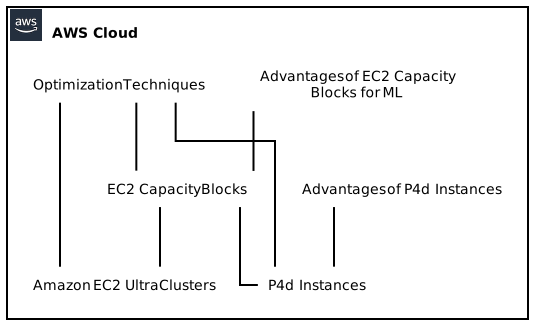
Throughout this guide, we will delve into the technical aspects of EC2 Capacity Blocks for ML, focusing on their advantages and how they can enhance your ML workflows. We will dive deeper into the expansion to P4d instances, discussing their unique features and benefits. Additionally, we will delve into relevant and interesting technical points that can optimize your ML workloads, with a strong emphasis on search engine optimization (SEO).
Let’s delve into the details!
Table of Contents
- Introduction
- Understanding EC2 Capacity Blocks
- Benefits of EC2 Capacity Blocks for ML
- Introducing P4d Instances
- Advantages of P4d Instances
- Optimizing ML Workloads with EC2 Capacity Blocks and P4d Instances
- Auto-scaling for efficient resource allocation
- Fine-tuning and pre-training in short durations
- Rapid prototyping with low-latency connectivity
- Handling surges in inference demand seamlessly
2. Understanding EC2 Capacity Blocks
EC2 Capacity Blocks provide the option to reserve GPU capacity in advance with more flexibility than ever before. With durations ranging from one to 14 days, and cluster sizes ranging from one to 64 instances (512 GPUs), EC2 Capacity Blocks cater to a wide range of ML workloads. These capacity blocks are housed in Amazon EC2 UltraClusters, ensuring low-latency, high-throughput connectivity.
By utilizing EC2 Capacity Blocks, users can secure the necessary GPU resources for their ML workloads, providing predictable and reliable performance. This level of control enables users to plan their ML projects with confidence, optimizing their resource allocation and meeting their project deadlines efficiently.
3. Benefits of EC2 Capacity Blocks for ML
EC2 Capacity Blocks offer several advantages for ML workloads:
3.1 Flexibility in Duration and Cluster Sizes
With EC2 Capacity Blocks, users have the flexibility to reserve GPU capacity for durations of one to 14 days. This freedom allows for efficient resource allocation, matching the specific needs of each ML workload. Additionally, the ability to choose cluster sizes ranging from one to 64 instances provides scalability, catering to projects of different scales.
3.2 Seamless Connectivity with Amazon EC2 UltraClusters
Amazon EC2 UltraClusters ensure low-latency, high-throughput connectivity for EC2 Capacity Blocks. This connectivity optimization enhances the performance of ML workloads, reducing latency and improving overall efficiency. With EC2 Capacity Blocks, users can achieve rapid and reliable data processing for their ML projects.
3.3 Cost Optimization with Reserved GPU Capacity
By reserving GPU capacity in advance, users can take advantage of discounts for longer durations. EC2 Capacity Blocks enable users to optimize their costs while maintaining consistent GPU performance for their ML workloads. This cost-efficiency is particularly beneficial for long-term ML projects or those with predictable resource requirements.
4. Introducing P4d Instances
With the expansion of EC2 Capacity Blocks for ML, Amazon EC2 now offers P4d instances. P4d instances are the latest addition to the P-series family and are specifically designed for ML workloads that require high-performance computing power. These instances are powered by NVIDIA A100 Tensor Core GPUs, providing accelerated performance for demanding AI and ML tasks.
P4d instances offer several unique features that make them ideal for ML workloads:
4.1 Enhanced GPU Performance
The NVIDIA A100 Tensor Core GPUs in P4d instances deliver exceptional performance for ML workloads. With their massive parallelism and advanced AI capabilities, P4d instances can handle the most demanding ML algorithms and models with ease. This enhanced GPU performance allows for faster model training and efficient data processing.
4.2 HBM2 Memory for Improved Memory Bandwidth
P4d instances are equipped with High Bandwidth Memory 2 (HBM2) for improved memory bandwidth. This feature enables faster access to GPU memory, reducing data access latency and increasing overall performance. With enhanced memory bandwidth, P4d instances are optimized for efficient data handling in ML workloads.
5. Advantages of P4d Instances
Utilizing P4d instances in conjunction with EC2 Capacity Blocks for ML offers numerous advantages:
5.1 Superior Performance for ML Workloads
The powerful NVIDIA A100 Tensor Core GPUs in P4d instances significantly enhance the performance of ML workloads. With their cutting-edge hardware capabilities, P4d instances can accelerate model training, enable seamless inferencing, and process data at an unprecedented speed. This superior performance allows users to complete ML projects faster, unlocking new possibilities for AI-driven applications.
5.2 Efficient Resource Allocation with GPU Capacity Reservation
Combining the benefits of EC2 Capacity Blocks with P4d instances, users gain full control over GPU resource allocation. By reserving GPU capacity in advance, users can ensure optimal resource utilization, avoiding any bottlenecks or resource shortages during critical project stages. This efficient resource allocation reduces costs and enhances productivity, allowing ML teams to focus on innovation rather than infrastructure management.
6. Optimizing ML Workloads with EC2 Capacity Blocks and P4d Instances
When leveraging EC2 Capacity Blocks for ML with P4d instances, there are several technical points that can be explored to further optimize your ML workloads. With a focus on SEO, let’s dive into some interesting points:
6.1 Auto-scaling for Efficient Resource Allocation
By implementing auto-scaling mechanisms, ML workloads can dynamically allocate the required GPU resources based on the workload’s demand. This ensures optimal resource allocation and eliminates the need to manually adjust cluster sizes. Furthermore, auto-scaling helps to maintain steady performance even during varying workloads, reducing bottlenecks and ensuring a seamless user experience.
6.2 Fine-tuning and Pre-training in Short Durations
EC2 Capacity Blocks’ flexibility in duration enables ML teams to efficiently perform fine-tuning and pre-training tasks within a short time frame. This is particularly beneficial for iterative model development, reducing the time required for experimentation and optimization. By taking advantage of shorter capacity block durations, ML teams can achieve faster iteration cycles, accelerating the overall development process.
6.3 Rapid Prototyping with Low-Latency Connectivity
With EC2 Capacity Blocks housed in Amazon EC2 UltraClusters, ML teams can leverage low-latency connectivity for rapid prototyping. This connectivity advantage enables faster data transfer and reduces feedback loop times, facilitating rapid experimentation and innovation. Rapid prototyping allows ML teams to quickly validate ideas and make informed decisions, leading to more efficient model development.
6.4 Handling Surges in Inference Demand Seamlessly
EC2 Capacity Blocks cater to surges in inference demand, as ML workloads can be scaled up or down based on the fluctuating workload requirements. By seamlessly handling these surges, EC2 Capacity Blocks ensure consistent performance and enhance user experience even during peak inference periods. This scalability is crucial for applications that experience variable inference demand, such as real-time recommendation systems or image recognition services.
Conclusion
In this comprehensive guide, we explored the expansion of EC2 Capacity Blocks for ML to include P4d instances in Amazon EC2 UltraClusters. We discussed the benefits of EC2 Capacity Blocks, highlighting their flexibility, connectivity advantages, and cost optimization features. Furthermore, we introduced P4d instances and their unique capabilities that make them ideal for resource-intensive ML workloads.
Additionally, we explored technical points that can optimize ML workloads further, focusing on SEO. By leveraging auto-scaling, short-duration fine-tuning, rapid prototyping, and efficient handling of inference surges, ML teams can maximize their productivity, performance, and cost-efficiency.
With EC2 Capacity Blocks and P4d instances, Amazon EC2 provides a powerful infrastructure to support a wide range of ML workloads. By adopting these technologies and implementing relevant optimization techniques, you can unlock new possibilities and drive innovation in the field of machine learning.