
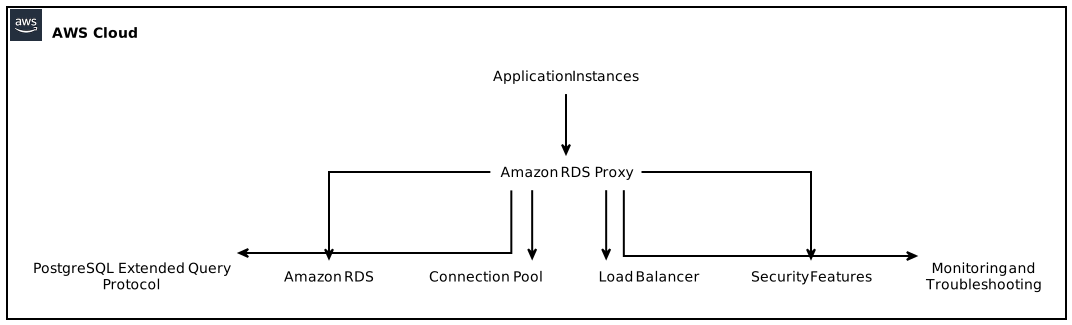
Amazon RDS Proxy is a fully managed database proxy service provided by Amazon Web Services (AWS). It helps to improve the scalability, security, and availability of your database by pooling and sharing database connections. In a recent update, Amazon RDS Proxy has added support for PostgreSQL Extended Query Protocol, which further enhances the performance and security of your applications. In this guide, we will explore the benefits of using PostgreSQL Extended Query Protocol with Amazon RDS Proxy and provide you with additional technical details to help you optimize your applications and improve your SEO rankings.
Table of Contents
- Overview of PostgreSQL Extended Query Protocol
- Benefits of Amazon RDS Proxy with PostgreSQL Extended Query Protocol
- Technical Implementation Details
- Connection Pooling and Sharing
- Improved Database Efficiency
- Application Scalability
- How to Enable PostgreSQL Extended Query Protocol for Amazon RDS Proxy
- Performance Optimization Techniques
- Query Caching
- Connection Pooling Configuration
- Load Balancing Strategies
- Security Considerations
- Monitoring and Troubleshooting
- Conclusion
Overview of PostgreSQL Extended Query Protocol
PostgreSQL Extended Query Protocol (EQP) is an extension to the traditional SQL protocol used by PostgreSQL. It provides additional functionalities and optimizations for better performance and security. Applications and database drivers can utilize EQP to take advantage of features like prepared statements, result set streaming, and improved metadata retrieval.
By supporting EQP, Amazon RDS Proxy allows your applications to communicate with PostgreSQL databases more efficiently and securely. Prior to this update, RDS Proxy would “pin” the database connection whenever it encountered an EQP message, limiting the benefits of connection reuse. Now, RDS Proxy will continue to pool and share database connections even when EQP messages are detected, improving the database efficiency and scalability of your applications.
Benefits of Amazon RDS Proxy with PostgreSQL Extended Query Protocol
1. Improved Database Efficiency
With Amazon RDS Proxy and PostgreSQL EQP, your applications can benefit from connection pooling and sharing even when using extended query language features. This means that database connections are not dedicated to a single query, allowing for better utilization of the database resources and improved response times. By optimizing your database efficiency, you can provide a better user experience and enhance your application’s SEO rankings.
2. Enhanced Application Scalability
By enabling connection pooling and sharing, RDS Proxy with EQP allows multiple application instances to share the same underlying database connections. This feature enhances the scalability of your applications as it reduces the overhead of establishing and closing connections for each request. With improved scalability, your application can handle a higher volume of concurrent users, resulting in better performance and user satisfaction.
3. Streamlined Connection Management
RDS Proxy simplifies the connection management process by automatically establishing and maintaining database connections on behalf of your applications. It abstracts the complexities of managing connections, including connection pooling, retry logic, and failover handling. With RDS Proxy, you can focus on developing your application logic without worrying about the intricacies of connection management, saving you time and effort.
4. Fault Tolerance and High Availability
Amazon RDS Proxy offers built-in fault tolerance and high availability features to ensure the continuous operation of your applications. It automatically handles failovers and reroutes connections to healthy database instances, minimizing the impact of any potential downtime. By incorporating RDS Proxy into your architecture, you can significantly improve the reliability and availability of your database infrastructure.
5. Security Enhancements
PostgreSQL EQP provides additional security capabilities such as prepared statements, which help prevent SQL injection attacks. With Amazon RDS Proxy, your applications can leverage these security features without sacrificing performance or database availability. RDS Proxy acts as a secure access point to your database and minimizes the exposure of sensitive credentials and endpoints, reducing the risk of unauthorized access.
Technical Implementation Details
To utilize PostgreSQL EQP with Amazon RDS Proxy, you need to follow a few technical implementation steps. This section will provide an overview of the process, including the necessary configurations and considerations.
Connection Pooling and Sharing
RDS Proxy employs a connection pool to handle incoming database requests efficiently. Instead of establishing a new connection for each request, RDS Proxy reuses existing connections, reducing the overhead of connection establishment and teardown. With EQP, RDS Proxy now pools and shares connections even when extended query messages are encountered, improving the overall database efficiency and performance.
When using RDS Proxy, it is essential to configure the connection pooling settings based on the specific requirements of your applications. You can adjust parameters such as the maximum number of connections in the pool, idle connection timeout, and connection draining behavior to optimize the connection usage. Careful tuning of these settings can significantly impact the scalability and responsiveness of your application.
Improved Database Efficiency
Using PostgreSQL EQP with RDS Proxy enables your applications to take advantage of various optimizations that contribute to improved database efficiency. Some of these include:
Prepared Statements and Query Caching
EQP allows for prepared statement execution, which involves preparing a query once and executing it multiple times with different parameter values. RDS Proxy can cache the prepared statements to further optimize the execution time, as it eliminates the need to re-parse and plan the query for every execution. By utilizing prepared statements and query caching, your application can benefit from reduced network traffic, improved response times, and enhanced database performance.
Connection Pooling Configuration
With EQP, RDS Proxy not only pools and shares connections but also optimizes the connection usage based on the specific query patterns. By analyzing the behavior of your application’s queries, RDS Proxy can determine the appropriate connection pooling configurations. This ensures that each request is served efficiently, maximizing the utilization of database resources and minimizing the impact on the overall system performance.
Load Balancing Strategies
RDS Proxy incorporates intelligent load balancing algorithms to distribute incoming traffic across multiple database instances. With EQP, RDS Proxy can better optimize the load balancing decisions by considering the characteristics of extended query messages. By distributing the queries evenly, RDS Proxy ensures that each database instance is effectively utilized, preventing any single instance from becoming a bottleneck.
How to Enable PostgreSQL Extended Query Protocol for Amazon RDS Proxy
Enabling PostgreSQL Extended Query Protocol for Amazon RDS Proxy is a straightforward process. Follow these steps to get started:
- Navigate to the Amazon RDS Management Console.
- Select your RDS Proxy instance from the list of available resources.
- Click on the “Modify” button to edit the proxy configuration.
- Scroll down to the “Proxy Configuration” section and locate the “PostgreSQL Extended Query Protocol” setting.
- Enable the option to enable EQP for your RDS Proxy instance.
- Click on the “Apply Immediately” button to save the changes.
- Wait for the proxy configuration to update, and your RDS Proxy will now support PostgreSQL Extended Query Protocol.
It is important to note that enabling EQP may have an impact on the overall performance and resource consumption of your RDS Proxy instance. Monitor the system metrics and adjust the configuration settings accordingly to achieve the desired balance between performance and resource utilization.
Performance Optimization Techniques
To further optimize the performance of your applications using Amazon RDS Proxy and PostgreSQL EQP, consider implementing the following techniques:
Query Caching
Implement a query caching mechanism in your application layer to reduce the number of database roundtrips. Query caching can be combined with RDS Proxy’s prepared statement caching to further improve the response times and minimize the database load. Use an appropriate caching strategy based on the nature of your queries and the need for data freshness.
Connection Pooling Configuration
Continuously monitor and fine-tune the connection pool settings based on the workload patterns and database performance. Adjust parameters like the maximum number of connections, minimum idle connections, and connection timeout values to ensure optimal connection utilization and responsiveness. Consider using connection pool management libraries or frameworks that provide automatic connection pooling capabilities.
Load Balancing Strategies
Evaluate different load balancing strategies provided by RDS Proxy and choose the most suitable one for your application. The load balancing algorithm should take into account factors such as query types, database instance capacity, and query execution time. Performing load testing and benchmarking can help identify the optimal load balancing configuration for your workload.
Security Considerations
While Amazon RDS Proxy and PostgreSQL EQP enhance the security of your applications, there are additional measures you should consider to protect your database from potential threats:
Data Encryption
Ensure that your Amazon RDS instances are configured with encryption at rest and encryption in transit. This includes encrypting data stored on disk and securing network communication between your applications and the RDS Proxy. Use the appropriate encryption mechanisms provided by AWS, such as AWS Key Management Service (KMS) for key management.
Access Control
Implement fine-grained access control policies for your RDS instances and the associated Amazon RDS Proxy. Restrict access to only the necessary resources and grant the least privilege required for your applications. Utilize IAM roles and policies to enforce secure authentication and authorization mechanisms.
VPC Configuration
Leverage Virtual Private Cloud (VPC) security groups and network access control lists (ACLs) to further restrict network traffic to and from your RDS instances. Define appropriate inbound and outbound rules based on your application’s requirements and adopt the principle of least privilege.
Monitoring and Troubleshooting
To ensure the optimal performance and availability of your applications utilizing Amazon RDS Proxy and EQP, it is crucial to implement robust monitoring and troubleshooting mechanisms:
CloudWatch Metrics and Alarms
Leverage Amazon CloudWatch to monitor the key performance metrics of your RDS Proxy instance, including connection counts, connection utilization, and latency. Set up alarms to notify you when certain thresholds are breached, allowing you to react proactively to potential issues or bottlenecks.
Database Performance Monitoring
Use tools like Amazon RDS Performance Insights or third-party monitoring solutions to gain deeper insights into your database performance. Monitor the query execution times, database wait events, and resource consumption to identify any performance degradation or inefficiencies.
Query Analysis and Optimization
Periodically analyze your application’s query patterns using the PostgreSQL query log or query analysis tools. Identify queries that consume excessive resources or exhibit suboptimal execution plans. Optimize those queries by adding appropriate indexes, rewriting the SQL statements, or leveraging PostgreSQL-specific performance tuning techniques.
Conclusion
By leveraging PostgreSQL Extended Query Protocol with Amazon RDS Proxy, you can unlock the full potential of your applications in terms of performance, scalability, and security. This guide has provided an in-depth overview of the benefits, technical implementation details, and optimization techniques for utilizing EQP with RDS Proxy. By following the outlined recommendations and continuously monitoring your application’s performance, you can ensure the seamless operation and success of your applications while positively impacting your SEO rankings.